Debunking the Climate Scam
Billions of Dollars -
Greedy Green Corporations -
No Warming For Two decades -
Bought and Paid For Organizations

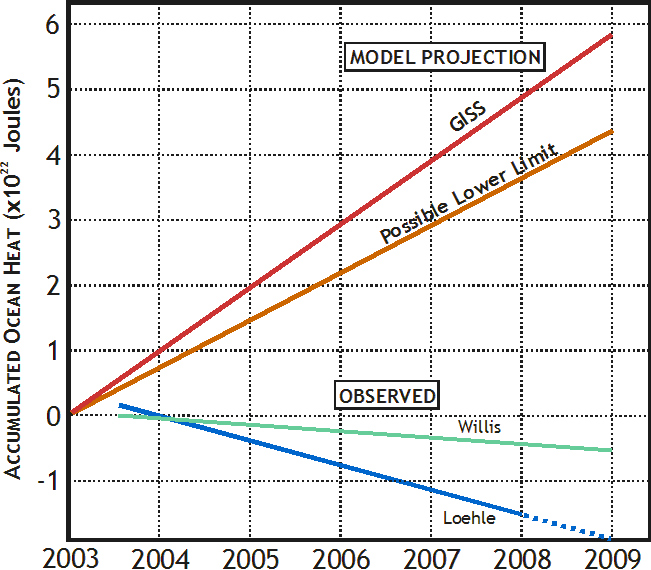
Global Warming Predictions Fail to Predict Ocean Cooling
The Global Warming Hypothesis and Ocean Heat
Albert Einstein once said, “No amount of experimentation can ever prove me right; a single experiment can prove me wrong.” Einstein’s words express a foundational principle of science intoned by the logician, Karl Popper: Falsifiability. In order to verify a hypothesis there must be a test by which it can be proved false. A thousand observations may appear to verify a hypothesis, but one critical failure could result in its demise. The history of science is littered with such examples.
A hypothesis that cannot be falsified by empirical observations, is not science. The current hypothesis on anthropogenic global warming (AGW), presented by the U.N.’s Intergovernmental Panel on Climate Change (IPCC), is no exception to this principle. Indeed, it is the job of scientists to expose the weaknesses of this hypothesis as it undergoes peer review. This paper will examine one key criterion for falsification: ocean heat.